For private landlords in England, the key electrical safety document is a satisfactory Electrical Installation Condition Report, usually called an EICR. The practical deadlines and five-year maximum explained below apply to England unless a section says otherwise. Scotland and Wales have separate frameworks, so landlords there should check current nation-specific guidance before relying on English requirements.
An EICR is not a certificate automatically issued after every electrical repair. It is a formal inspection and test of the property's fixed electrical installation, designed to identify whether the wiring and associated fixed equipment remain safe for continued use.
What electrical safety certificate do UK landlords need?
Landlords generally need a satisfactory EICR for rented homes. The report covers the fixed installation: consumer units, wiring, sockets, light fittings, switches and other permanently connected electrical components.
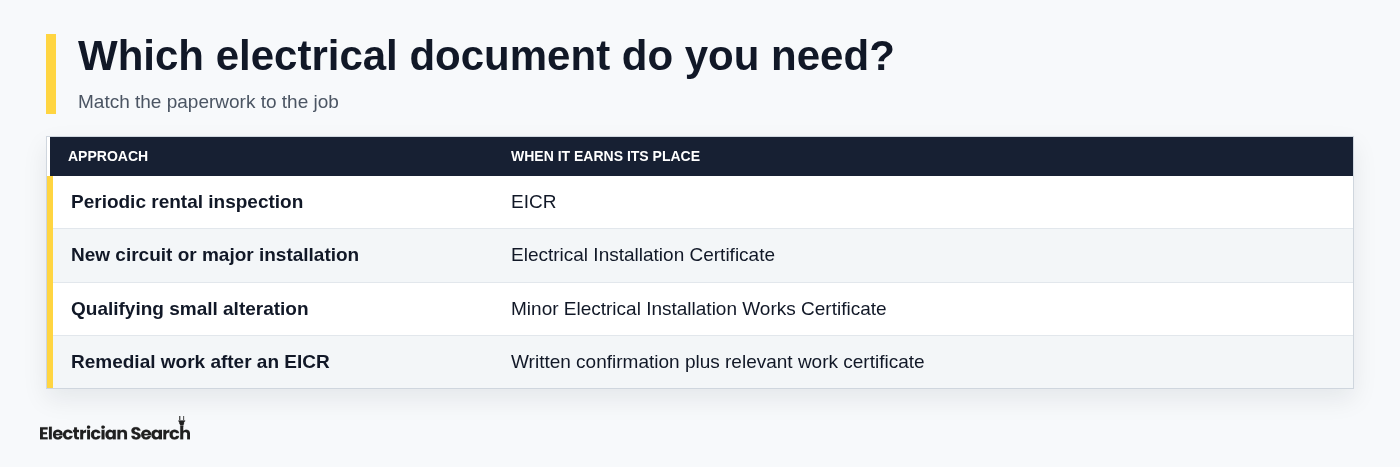
The wording "electrical safety certificate" is commonly used, but the document required for periodic rental checks is normally an EICR. An electrician may issue other paperwork after installation or repair work, such as an Electrical Installation Certificate or Minor Works Certificate. Those documents do not automatically replace a periodic EICR. For more detail, see what certificate should an electrician provide after work.
In practical terms, a landlord needs to arrange the inspection before a new tenant moves in, keep the resulting report, and arrange future inspections within the required period or sooner if the report says so.
The core EICR requirements landlords must meet
The central duty is straightforward: arrange inspection and testing of the fixed electrical installation by a qualified, competent person, then keep and share the paperwork as required. Do not treat the report as a one-off administrative task. Its recommendations and stated next-inspection date matter just as much as obtaining it.
For private rented property, five years is usually the maximum inspection interval. However, the electrician can recommend a shorter interval where the installation's condition justifies it. A landlord cannot simply ignore that recommendation and rely on the five-year maximum.
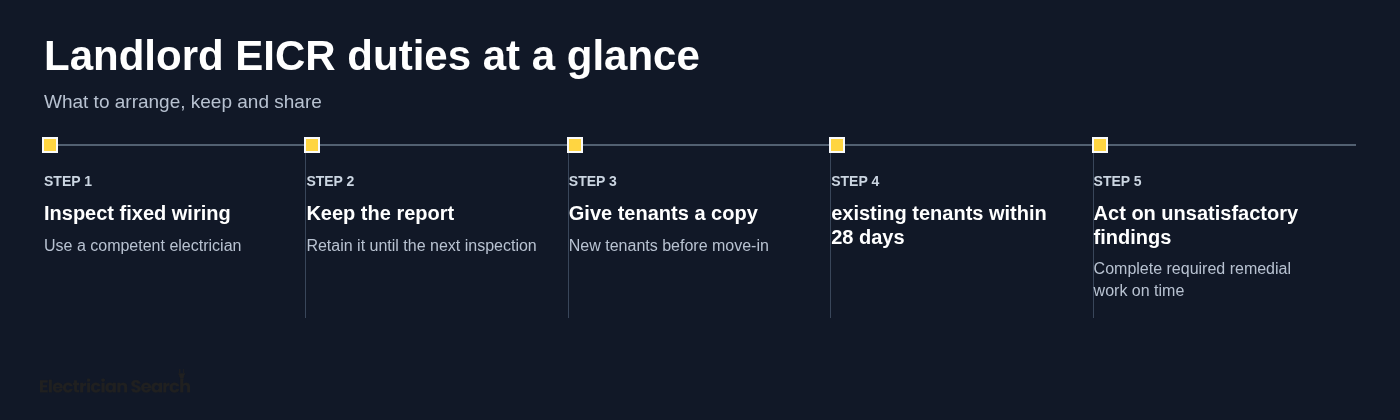
- Arrange inspection and testing of the fixed electrical installation.
- Keep the EICR until the next inspection is due.
- Give tenants copies within the applicable deadlines.
- Provide the report to the local housing authority if it makes a written request.
- Complete necessary remedial work where the report identifies safety concerns.
This requirement is about the property's fixed system, not every appliance in the home. Portable appliance testing can be sensible for landlord-provided appliances, but PAT testing is separate from an EICR. Tenant-owned appliances are not normally part of the landlord's fixed-installation inspection either.
When must landlords give tenants the EICR?
Timing matters. A new tenant should receive a copy of the current EICR before they occupy the property. Existing tenants should receive a copy within 28 days of the inspection and test being completed.
If a prospective tenant makes a written request, the landlord generally has 28 days to provide a copy. A local housing authority can also request the report in writing, and the usual deadline for supplying it is seven days.
Keep evidence that the report was delivered. An email with the report attached is useful because it creates a dated record, while a signed acknowledgement can help where paperwork is handed over in person. Store this alongside the EICR itself, not in a separate untraceable inbox or file.
When is the next EICR due: 3 years or 5 years?
For private rented homes in England, five years is the maximum interval between inspections. But five years is not automatic: the next-inspection date or interval on the report controls if the inspector recommends an earlier inspection.
A three-year recommendation may be appropriate where an installation is older, has a history of defects, has suffered damage, has changed use, or needs closer monitoring after previous observations. The same applies when an electrician identifies conditions that make a shorter cycle prudent.
For example, a modern, well-maintained flat may receive a five-year recommendation. A property with ageing wiring, signs of wear, or previous unsatisfactory findings may need another inspection sooner. Put the next due date in a calendar as soon as the report arrives rather than relying on memory.
What happens if the EICR is unsatisfactory?
An unsatisfactory EICR means the installation requires action before it can be treated as compliant. Reports commonly use observation codes, and C1, C2 and FI observations generally make the report unsatisfactory until the issue is properly addressed.
C1 indicates danger is present and urgent action is needed. C2 indicates a potentially dangerous condition requiring improvement, while FI means further investigation is required without delay. The right response is not to choose the cheapest wording or assume a note can wait until the next tenancy; it is to have the issue assessed and dealt with by a competent electrician.
Required remedial work, or written confirmation that further work is unnecessary, must usually be completed within 28 days. If the report specifies a shorter timescale, that shorter period applies. Once the work is complete, keep written confirmation and provide it to the tenant and, where requested, the local authority.

Which UK rental properties and landlords are covered?
Private rented houses and flats are the main properties covered by landlord electrical safety rules. That includes ordinary residential lets where a landlord provides a home under a tenancy or, in Wales, an occupation contract.
Not every arrangement fits neatly into the same rules. Social housing, holiday lets, lodger arrangements, shared accommodation and some specialist tenancies can be subject to different standards, exemptions or obligations. The exact answer can depend on where the property is located and the legal nature of the occupation.
Do not assume that "UK requirements" are identical across all four nations. England, Scotland and Wales have their own housing frameworks. Landlords with unusual property arrangements should check the current rules that apply to their nation and tenancy type before deciding that an EICR is unnecessary.
EICR rules in England, Scotland and Wales
England: Private landlords must meet the Electrical Safety Standards in the Private Rented Sector framework. The fixed electrical installation must be inspected and tested at intervals of no more than five years, or sooner if the report requires it, with copies supplied to tenants and the local authority when requested.
Scotland: Scotland has separate private rented housing standards. Check current Scottish guidance for the applicable inspection interval, document-sharing deadlines and remedial-work requirements rather than relying on the English framework.
Wales: Wales operates through its occupation-contract framework and has its own electrical safety requirements for rented homes. Check current Welsh Government guidance for the applicable inspection interval, document-sharing deadlines and remedial-work requirements rather than relying on requirements written for England.
How much does an EICR cost for a rental property?
There is no single correct EICR price. The cost depends on the property's size, number of circuits, age of the installation, accessibility of the consumer unit and electrical accessories, the region, and the time needed to test the installation properly. For broader guidance, see how much it costs to hire an electrician in the UK.
Remedial work is usually a separate expense. A low inspection quote may cover the report alone, not replacement components, repairs, return visits or a reinspection after faults have been corrected. That does not necessarily make the quote poor value, but it does mean landlords should compare like with like.
Ask for a written scope before booking. Confirm whether the price includes testing, the completed report, travel, follow-up documentation and any charge for returning after remedial work. A clear quote is more useful than an attractive headline figure with unclear exclusions.
EICR, Electrical Installation Certificate and Minor Works Certificate: know the difference
An EICR assesses the condition of an existing fixed electrical installation. It is the document associated with periodic inspection of a rental property, not evidence that every part of the installation is newly installed.
An Electrical Installation Certificate, often called an EIC, is normally issued for new installation work or significant alterations, such as a new circuit or a major electrical installation. A Minor Electrical Installation Works Certificate may be suitable for qualifying smaller additions or alterations.
After work is completed, ask the electrician what paperwork applies to that job. You may need an installation certificate or minor works certificate, plus any required Building Regulations notification. Do not assume a new EICR is always needed simply because a repair or alteration has been carried out.
How to arrange an EICR and keep an audit trail
Start by finding a competent electrician who carries out rental-property inspections and can provide a clear written report. Share previous EICRs where available, especially if they contain recommendations or outstanding observations that may affect the inspection.
- Check the electrician's relevant qualifications, registration or competent-person scheme membership where applicable, insurance and written pricing.
- Confirm the appointment covers an EICR, not just a visual check.
- Make sure there is access to the consumer unit, sockets, lighting points and relevant areas of the property.
- Tell tenants what access is needed and arrange the visit with appropriate notice.
- Save the report, tenant delivery record, remedial invoices and confirmation of completed work together.
Landlords searching for an electrical inspection nearby can read this guide to finding an electrical inspection near me, then use a local directory to shortlist providers. ElectricianSearch can help you find nearby electrical professionals to contact directly.
Stay compliant between electrical inspections
Electrical compliance is easier when it is managed as a record-keeping routine rather than an emergency before a tenancy begins. Schedule the next inspection before the due date, respond quickly to safety concerns, and keep the EICR, tenant delivery evidence and remedial documents in one accessible file.
If you need to arrange an inspection, use ElectricianSearch to find nearby electrical professionals and contact providers that appear suitable for your rental property.