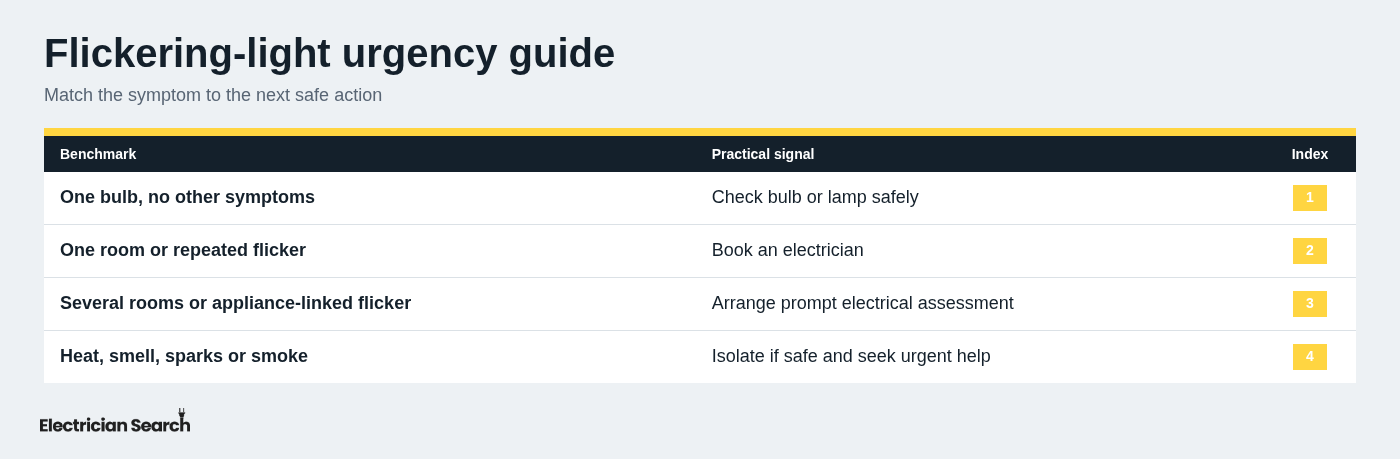
Flickering lights are not always an emergency, but they should not be ignored when they persist, affect several lights, or appear alongside heat, buzzing, burning smells, sparks, shocks, or tripped breakers. In those situations, call a qualified electrician promptly rather than hoping the problem settles down.
A single light bulb that occasionally flickers may be as simple as a loose, ageing, or incompatible bulb. But multiple lights flickering in a house, or lights that react when appliances switch on, can point to a fault that needs professional investigation.
When flickering lights mean you should call an electrician
Call an electrician if flickering keeps happening, spreads beyond one fitting, affects more than one room, or comes with any other electrical symptom. The same applies if lights noticeably dim when you use an appliance, especially if this is new or worsening.
Act more urgently if you notice a burning smell, smoke, sparking, crackling, a hot switch or fitting, discolouration around an accessory, an electric shock, or repeated breaker trips. If it is safe to do so, switch off the affected circuit at the consumer unit. Do not touch damaged equipment. If there is active smoke, fire, or visible arcing, leave the area and seek emergency assistance; for heat, smells, or repeated tripping without those active signs, arrange urgent electrical help.
The important distinction is between an isolated, easily explained bulb issue and a recurring electrical pattern. A flickering light bulb is not automatically dangerous, but it is not proof that everything behind it is safe either.
Start by identifying the pattern of the flicker
The quickest way to decide how seriously to treat flickering is to look at the pattern: what flickers, when it flickers, and what else changes at the same time. This information will also help an electrician narrow down the fault when they arrive.
Do not try to diagnose wiring from the pattern alone. Different faults can create similar symptoms, and electrical testing is needed to establish the actual cause.
One light bulb or one fitting flickers
One flickering light is often the lower-risk scenario. The bulb may be nearing the end of its life, not seated properly, incompatible with a dimmer, or installed in a lamp or fitting with a developing fault.
For a removable bulb, switch the light off, allow the bulb to cool, and replace it with the correct type and rating for the fitting. If the light is controlled by a dimmer, make sure the replacement LED is suitable for dimming. A non-dimmable LED on a dimmer circuit is a common reason for flickering.
Do not continue with checks if the fitting is hot, cracked, discoloured, loose, damaged, or still flickers with a suitable replacement bulb. Switch off power before touching a fixed fitting, and leave wiring, ceiling connections, and switches to an electrician.
Multiple lights flicker in one room or across the house
Several lights flickering in one room is more concerning than one faulty bulb. It can be associated with a circuit fault, deteriorated connection, switch or fitting problem, or another issue affecting that part of the installation.
If lights flicker in several rooms or throughout the home, arrange an electrician promptly. Wider flickering can sometimes involve a neutral connection or an incoming supply issue, both of which need proper assessment. Repeatedly resetting breakers or opening switches and fittings will not solve the underlying problem and can add risk.
Lights flicker when an appliance turns on
A very brief dip in brightness when a high-demand appliance starts can occur, particularly in older homes. But recurring, obvious, or severe flickering when appliances run is not something to dismiss.
Showers, kettles, washing machines, tumble dryers, fridges, and other motor-driven appliances can be useful clues. Note whether the lights flicker when a particular appliance starts, heats up, or changes cycle. The fault could involve the appliance, its circuit, a connection, or the capacity and condition of the installation.
Red flags that make flickering lights urgent
Flickering becomes an urgent safety issue when it is accompanied by signs of overheating, arcing, or electrical damage. Turn off the affected circuit if you can do so safely, stop using the affected equipment, and contact an emergency electrician when there is an immediate risk.
- Burning, fishy, or melting-plastic smells near a light, switch, socket, or consumer unit
- Smoke, sparks, visible arcing, or crackling noises
- Hot switches, fittings, plugs, or cables
- Brown marks, scorch marks, melting, or discolouration
- Electric shocks or tingling when touching an accessory
- Breakers that repeatedly trip or refuse to stay on
- Flickering that is rapidly becoming more frequent or severe
Do not remove covers to look for a loose wire. Do not touch a sparking switch, a hot fitting, or a damaged consumer unit. The safest response is to isolate power where safe and leave the inspection to a qualified professional.
Common causes an electrician may investigate
Flickering can result from something relatively simple, such as an unsuitable LED bulb, or from a fault hidden in a circuit. An electrician will investigate the symptom rather than assume the answer from a visual check.
Common areas include loose or deteriorated connections, worn switches, damaged light fittings, incompatible LED and dimmer combinations, overloaded circuits, and faulty appliances. They may also check the consumer unit and circuit protection, particularly where breakers trip or the flickering is widespread.
Can it be a breaker issue if a light flickers? It can be related, particularly if a breaker has tripped or there is a fault on that circuit. However, flickering by itself does not identify the breaker as the cause. A breaker is a protective device, and the reason it operates may be elsewhere in the circuit or in connected equipment.
In some cases, the issue may be on the electricity supply side rather than within the home's wiring. If tests point that way, the electrician can advise on the appropriate route for reporting it to the network operator.
Safe checks you can make before booking an electrician
You do not need to take electrical fittings apart to provide useful information. A few safe observations can make the appointment more efficient and help you explain why the fault needs attention.
- Identify which lights flicker and whether they are in one room, one circuit, or several areas of the home.
- Write down when it happens: continuously, at certain times, or when an appliance is used.
- Note whether any breaker has tripped, without repeatedly trying to reset it.
- Check whether the bulb type is appropriate for the fitting and, where applicable, the dimmer switch.
- Record any accompanying heat, noise, smell, visible damage, or power loss.
If you replace a bulb, switch it off first and wait for it to cool. Use the correct replacement bulb and avoid forcing it into the fitting. Do not inspect wiring behind a switch, ceiling rose, or consumer unit, even if the problem appears localised.
Why flickering lights can raise fire-risk concerns
Flickering lights do not directly cause an electrical fire. The concern is the fault that may be causing the flicker, such as a loose connection, overheating component, arcing, damaged fitting, or faulty appliance.
Loose connections can generate heat, while arcing can create sparks and damage surrounding materials. That is why a flicker paired with buzzing, heat, a burning smell, visible damage, or worsening behaviour should be treated as a warning sign rather than a minor annoyance.
There is no need to panic over every unstable LED bulb. But it is sensible to act early when the cause is unclear, because a professional assessment can identify and repair a developing fault before it becomes more disruptive or hazardous.
What an electrician will check during a visit
An electrician will normally begin by establishing the scope of the problem: which fittings are affected, whether appliances trigger it, whether protective devices have operated, and whether there are visible signs of damage.
They may inspect the affected lights, switches, circuit protection, and relevant connections, then carry out appropriate electrical tests. Depending on the findings, the electrician may isolate a circuit, repair or replace a faulty fitting or component, address an appliance-related issue, or recommend further action.
After the work, ask what documentation applies to the job. This guide explains what certificate an electrician should provide after work.
If the evidence suggests an incoming supply problem, the electrician may advise that the electricity network operator needs to investigate. The right repair should follow test results, not a guess based solely on a flickering bulb.
Finding the right electrician for a flickering-light fault
For persistent or widespread flickering, look for a suitably qualified, registered electrical professional and describe the symptoms clearly before the visit. Mention how many lights are affected, whether a particular appliance triggers the issue, whether breakers have tripped, and whether there are urgent signs such as heat or burning smells.
Use this electrician near me checklist to compare local professionals and ask the right questions before booking. If there is smoke, sparking, or an actively hot fitting, make the urgency clear when seeking help. For less immediate faults, a local directory can make it easier to find nearby providers and compare relevant electrical services.
ElectricianSearch

ElectricianSearch helps homeowners find nearby listed electrical professionals by location and browse city-based electrician listings. It is most useful when you need a practical starting point for contacting local providers after deciding that flickering needs professional attention.
It is a provider-discovery directory, not an official certification lookup or an independent guarantee of price, availability, or service quality. Check that the electrician is suitable for the work, explain the fault in detail, and ask about availability if the symptoms are urgent.
Treat persistent or widespread flickering as a repair signal
One loose or failing bulb can be a straightforward fix. Persistent flickering, multiple lights flickering in the house, appliance-linked dimming, tripping breakers, or any sign of heat, smell, sparks, or smoke should be treated as a repair signal.
Do not attempt to work on fixed wiring to solve it. When an inspection is needed, use ElectricianSearch to find nearby listed electrical professionals and arrange the right help.