
A cheap electrician estimate can become an expensive job when nobody has agreed what is actually included. A clear estimate is not just about the total: it should show the work, materials, likely unknowns, paperwork and payment expectations well enough for you to compare providers fairly.
Use this checklist before requesting prices, during conversations with electricians and again before approving work. It will help you ask better questions without pretending that every electrical job can be priced accurately from a few photos.
Before you request an electrician estimate
Start by understanding the difference between an estimate and a fixed quote. An estimate is an informed expectation of cost based on the information available. A fixed quote is a defined price for a defined scope of work. If the scope changes, the fixed price may no longer apply.
For a straightforward planned job, such as replacing a known number of light fittings, an electrician may be able to provide a useful price remotely. For concealed wiring, consumer-unit work, fault finding or a larger installation, a site visit is often the sensible route. Nobody can reliably see damaged cables behind plaster or assess an existing circuit from a short description alone.
Before contacting anyone, prepare the basics below. This gives each electrician a similar starting point and makes later comparisons much easier.
- Describe the problem or goal. State what is happening now and what you want once the work is complete. For example, "Two kitchen sockets intermittently lose power" is more useful than "electrics not working."
- Identify the property type. Say whether it is a flat, terrace, semi-detached house, older property, rental or commercial space. Construction, access and the age of the installation can affect the approach.
- Note access constraints. Mention restricted parking, upper-floor access, tenants, pets, working hours, locked communal entrances or furniture that may need moving.
- Set out your timing. Give preferred dates and say whether the issue is urgent. Do not label a job an emergency simply to speed up booking; urgent attendance may carry a different call-out cost.
- Separate symptoms from assumptions. Explain what you have observed, but avoid diagnosing the cause yourself. A tripping circuit does not automatically mean the consumer unit needs replacing.
Essential details to give the electrician
A short, consistent job brief helps an electrician decide whether to visit, what questions to ask and how much confidence to place in an initial estimate. Copy and adapt this template for each provider you contact.
Job brief template: "Property type: [type]. Location of work: [rooms/areas]. Issue or planned work: [clear description]. Quantity: [number of sockets, lights, circuits or appliances]. Existing issues: [tripping, damage, age, previous work]. Access and parking: [details]. Preferred dates: [details]. Photos attached: [what they show]."
- State the room and exact location. "Bedroom" is a start; "rear bedroom, two wall sockets beside the window" is far easier to scope.
- Describe symptoms or planned work. Include when an issue occurs, what trips or stops working, and whether it affects other parts of the home. For planned work, say what you want installed, moved or replaced.
- Count fittings and accessories. List quantities and types: six recessed downlights, three double sockets, one extractor fan or one new cooker connection, for example.
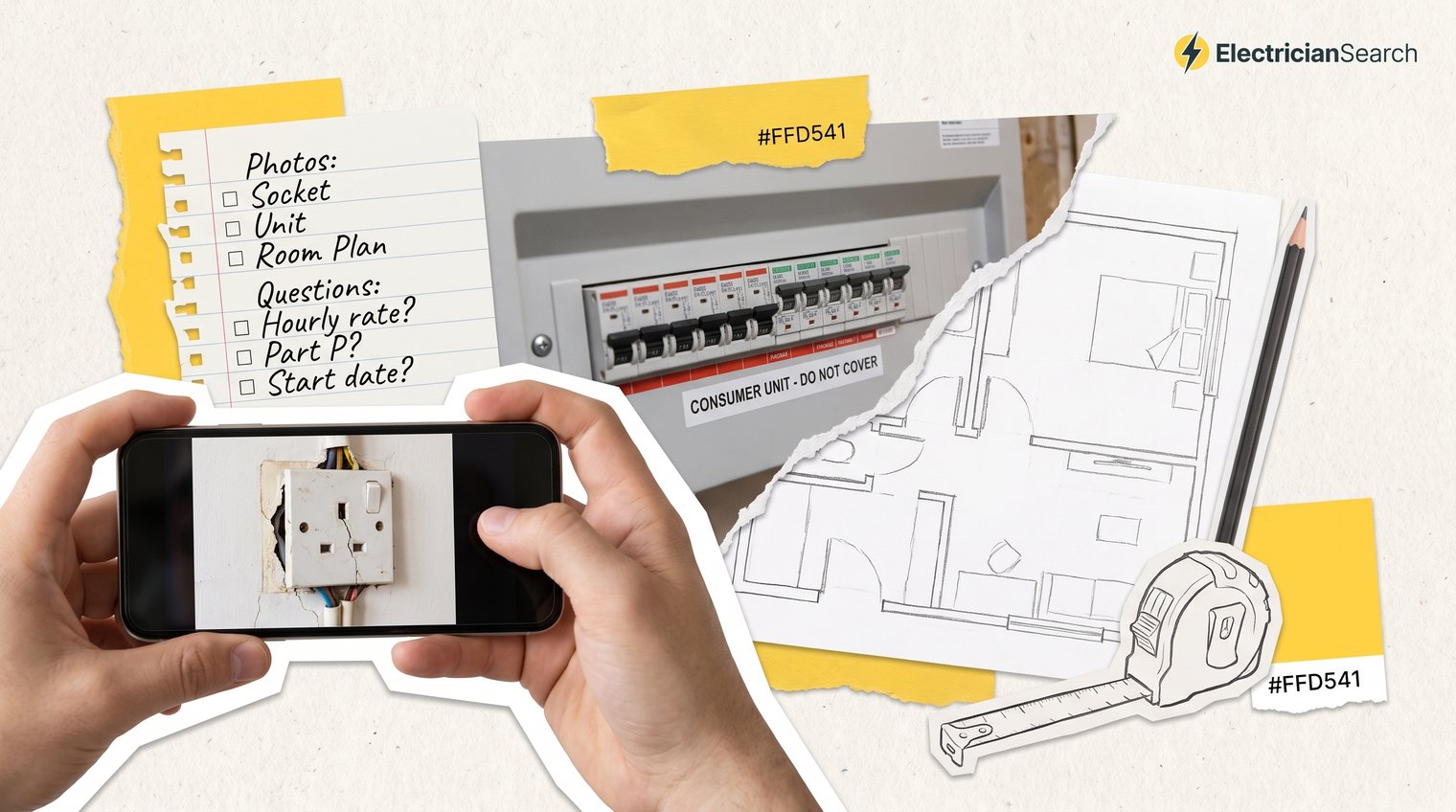
- Send useful photos. Photograph the work area, existing fittings, visible cable routes where relevant and the labels on the consumer unit. Do not remove covers or touch exposed wiring to get a better photo.
- Flag existing electrical concerns. Mention recurring trips, signs of heat damage, loose sockets, water ingress, old wiring or previous unfinished work. These may change the scope.
- Include makes and models when relevant. This matters for items such as an electric shower, cooker, EV charger, extractor fan or replacement consumer-unit components.
- Explain parking and site access. Parking charges, permit requirements and difficult access can affect the practical cost of the visit.
- Give realistic preferred dates. State whether you need a particular day, whether someone will be home and whether the work must fit around other trades.
Accurate information improves comparability, but it does not replace an inspection when the electrician needs to inspect circuits, test faults or assess concealed conditions.
The scope of work checklist
The most useful electrician estimate is built around a line-by-line scope, not a broad label such as "kitchen electrical work." That label could mean replacing one fitting, adding circuits, moving sockets, fitting appliances and testing the installation - all with very different time and material requirements.
Ask for the work to be described room by room or task by task. For each line, establish what will be supplied, where it will be fitted, how many items are included and what assumptions sit behind the price.
- List each task separately. For example: isolate supply, remove old pendant, install four customer-selected light fittings, test operation and issue relevant paperwork if applicable.
- Confirm quantities and locations. A price for "new sockets" is incomplete without the number, position and whether chasing or surface trunking is expected.
- Ask about removal and making-good. Check whether old fittings will be removed and disposed of, and whether lifting floorboards, chasing walls, patching plaster or redecorating is included or excluded.
- Request stated assumptions. An estimate may assume accessible routes, sound existing wiring, suitable capacity or customer-supplied fittings. Those assumptions should be visible, not buried in a conversation.
Labour and investigation
Planned installation work and fault finding should not be treated as the same type of job. Installation can often be scoped in advance; diagnosis may require testing and investigation before the cause, repair and final cost are known.
- Confirm any call-out or survey charge. Ask what the fee covers, how long the visit allows for and whether it is deducted from the final invoice if you proceed.
- Ask how diagnostic time is charged. For a fault, establish whether there is a minimum charge, an hourly rate or a staged investigation process.
- Check how many people are included. Some jobs need two electricians or an additional person for safe access, lifting or faster completion. The estimate should not leave this unclear.
- Clarify hourly or day rates where applicable. This is especially important where the scope cannot be fully confirmed until work starts.
- Ask about travel and parking charges. If these are separate, they should be shown before you agree to an appointment.
Materials and electrical equipment
Material allowances can make two estimates look similar when they are not. One electrician may have allowed for a basic accessory range, while another has priced specific branded fittings and protective devices.
- Request the brand, model or specification. This is particularly important for light fittings, sockets, switches, cables, circuit protection and consumer-unit components.
- Confirm what is supplied by whom. If you buy your own fittings, check they are suitable and ask whether the electrician has any conditions around customer-supplied equipment.
- Ask how material changes are handled. Find out whether the price includes a fixed allowance, whether materials are subject to price movement and whether substitutions need your approval.
- Clarify pricing treatment. You do not need to demand a supplier invoice, but you should know whether materials are included as a total, charged separately or subject to an agreed markup.
Testing, certification and notification
Testing and paperwork are part of completing many electrical jobs properly, not an optional afterthought. The exact certificate depends on the nature and extent of the work, so do not assume every small task produces the same document. For more detail, see What Certificate Should an Electrician Provide After Work?
- Ask whether testing is included. The estimate should say whether testing and inspection form part of the stated price.
- Confirm the expected certificate. Depending on the work, this may include an Electrical Installation Certificate or a Minor Electrical Installation Works Certificate. Ask what is appropriate for your job.
- Clarify notification responsibility where relevant. For work that requires Building Regulations notification, ask who will handle it and what confirmation you will receive.
- Include paperwork in the scope. If certification matters to your property records, it should be listed in writing rather than promised informally.
What should be included in a written electrician estimate
Even a small job benefits from a written estimate. It gives both sides one version of the agreed work, makes follow-up questions easier and reduces the risk of a disagreement based on memory.
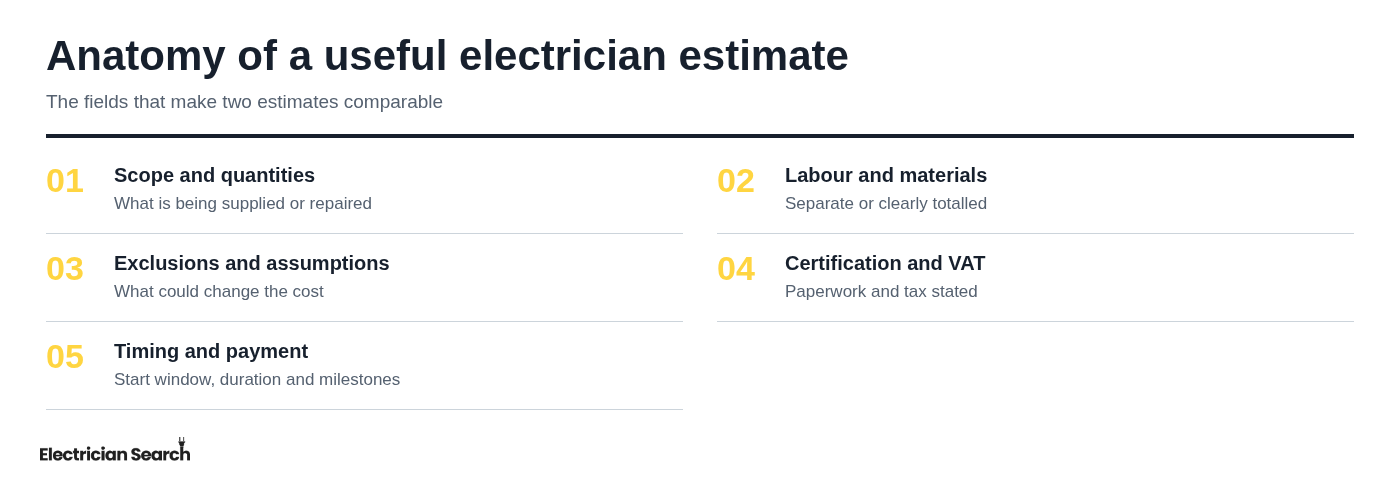
- Contractor identity and contact details. The estimate should identify the business or person providing it and provide a reliable way to contact them.
- Issue date and validity period. Material prices and availability can change, so know how long the estimate remains valid.
- A clear scope of work. It should describe tasks, quantities, locations and materials well enough to tell what has been allowed for.
- Exclusions and assumptions. This is where access limits, concealed defects, decorating, customer-supplied items or other potential cost changes should be stated.
- Labour and materials. These can be shown separately or clearly totalled, but avoid an unexplained figure where you cannot see what it covers.
- VAT status. Ask whether VAT is included, excluded or not applicable. A missing VAT position makes prices hard to compare.
- Payment schedule. State deposits, stage payments and final payment timing rather than leaving money discussions until work is underway.
- Start window and estimated duration. A realistic timeframe helps you coordinate access, other trades and disruption at home.
- A variation process. The written estimate should explain how additional work, discoveries or customer changes will be approved and priced.
Keep the estimate, messages, relevant photos, invoices and final electrical certificate in one place. They are useful records for future maintenance, insurance questions, selling the property or checking exactly what was done.
Questions to ask before accepting the estimate
Prioritise the questions that affect final cost, safety and deliverables. Once those are clear, move on to convenience and upgrade options.
Essential questions
- Is this an estimate or a fixed quote? Ask directly, because the wording affects how much price certainty you have.
- What could increase the price? Ask for specific triggers, such as inaccessible routes, damaged wiring, extra fittings or a need for additional circuit work.
- What is excluded? Establish whether making-good, decoration, waste removal, specialist access or customer-selected fittings are outside the price.
- Is VAT included? Make this clear before comparing totals from different providers.
- What certificate or paperwork will I receive? The answer should match the nature of the work, not a generic promise.
- Who will carry out the work? Confirm whether the person who surveyed the job will attend, and who is responsible for the installation and testing.
Useful but non-essential questions
- Are there lower-cost material options? Ask only after ensuring the alternative is suitable for the intended use and does not remove required work or testing.
- What is the lead time for parts? This matters for specialist fittings, consumer-unit equipment and items you want matched to an existing finish.
- How will dust and disruption be managed? Ask about floor protection, isolation periods, access to rooms and clearing the work area.
How to compare electrician estimates fairly
The lowest headline figure is not automatically the best value. A lower estimate may omit materials, VAT, testing, certification, making-good or the labour needed to deal with a realistic site condition.
Use a simple comparison process rather than trying to judge each total in isolation.
- Normalise the scope first. Make sure each provider is pricing the same number of fittings, rooms, circuits and tasks. If one estimate says "install kitchen lighting" and another lists eight downlights and two switches, ask for the first one to be clarified.
- Highlight unmatched lines. Mark every item that appears in one estimate but not another, including materials, waste removal, testing and certificates.
- Compare specifications, not labels. Check the stated fitting range, cable work, protective devices and any allowances. A vague materials line is not directly comparable with named equipment.
- Check VAT and allowances. Confirm whether each total includes VAT and whether any part is provisional or subject to later confirmation.
- Compare timing and duration. A provider who can start sooner may be valuable, but rushed work or an unrealistic one-day promise should prompt questions.
- Clarify differences in writing. Send the same focused question to each electrician and keep the response with the estimate.
Warning signs include vague lump sums, no VAT status, no assumptions, unusually low material allowances and no explanation of testing or certification. These are not automatic proof that a provider is unsuitable, but they are reasons to pause and request detail before accepting.
Estimate, quote, call-out fee and fixed price: know which one you have
These terms are often used casually, but they affect how you plan for cost.
- Estimate: An expected cost based on available information. The final amount may change if the actual work differs from the assumptions.
- Quote: A stated price for a clearly defined scope. Read the scope and exclusions closely, because they define what the price covers.
- Fixed price: A price intended not to change for the agreed work. It generally does not cover extra work, hidden defects or changes you request after approval.
- Call-out fee: A charge for attending, often associated with urgent work or fault investigation. Confirm what time, diagnosis or initial work is included.
When additional work is discovered on site, ask for a revised written estimate or quote before approving it. You may need to make a quick decision in a genuine safety situation, but the pricing basis should still be explained as clearly as circumstances allow.
Estimates are not always free. Some electricians provide free estimates for simple planned work, while a site survey, fault diagnosis, urgent visit or complex specification may be chargeable. Confirm the fee in advance and ask whether it will be credited against the job if you go ahead.
Check the electrician's credentials and job fit
A directory listing, logo or polished estimate is not proof that a provider is right for your job. Treat the estimate as one part of the decision and check the person or business carrying out the work. If you are still looking for local providers, use this Electrician Near Me: 9-Point Checklist for Choosing a Local Pro.
- Confirm the business identity. Make sure the name, contact details and person you are dealing with are consistent across the estimate, messages and invoice.
- Ask about insurance where relevant. For work in your home, it is reasonable to ask about appropriate insurance cover, particularly for larger or more disruptive projects.
- Check relevant competence or registration. For work that is notifiable or requires specific certification, ask how the electrician is able to undertake and certify it.
- Ask about experience with your type of job. An electrician may be excellent at domestic fault finding but not regularly install EV chargers, work in period properties or manage larger refurbishment projects.
- Confirm willingness to provide appropriate certification. The expected paperwork should be discussed before work begins, not raised after the final invoice.
- Clarify who will attend. If the estimator and installer are different people, ask who will be on site and who is responsible for the finished work.
Agree how changes and unexpected problems will be handled
Electrical work can reveal conditions that were not visible at the estimating stage. A clear change process does not mean expecting problems; it means avoiding surprise invoices if a genuine issue is found.
- Require approval before additional work starts. Agree that no extra chargeable work will be carried out without your authorisation, except where immediate action is necessary to make a dangerous situation safe.
- Get a written variation description. It should explain what has changed from the original scope and why the added work is needed.
- Confirm the new price or pricing basis. Ask for a fixed addition where possible, or an hourly rate and material allowance where the extent is still uncertain.
- Record the schedule impact. Extra work can move the completion date, especially if parts must be ordered or access needs changing.
- Ask for supporting evidence. Photos or an on-site explanation can help show hidden damage, unsuitable existing circuits or inaccessible cable routes.
Common cost-changing discoveries include damaged wiring, cable routes that cannot be accessed as expected, unsuitable existing circuits, asbestos concerns and customer-selected upgrades. These are legitimate reasons to revisit an estimate, but not reasons to leave the final cost entirely open-ended.

Use the estimate to plan payment and timing
Payment terms should reflect the size and structure of the job. A small repair may be invoiced on completion, while a larger installation may reasonably involve deposits and agreed stage payments for materials and completed work.
- Confirm the deposit amount and purpose. Ask what it covers, such as ordering specific equipment or reserving time in the schedule.
- Match larger payments to verifiable stages. For a substantial project, link payments to clear milestones rather than paying the full amount before work begins.
- Agree invoice timing and payment methods. Know when invoices will be issued and which payment methods are accepted so there is no last-minute confusion.
- Check cancellation and rescheduling terms. This matters when equipment has been ordered, access has been booked or you may need to coordinate several trades.
- Record the estimated start date and duration. Treat these as a planning window unless the electrician has committed to specific dates in writing.
- Note the estimate validity period. If you wait beyond it, ask for confirmation that the price and material availability still stand.
Avoid paying the full job value upfront. For larger work, staged payments tied to completed, visible progress are usually easier for both sides to manage.
A final electrician estimate checklist before you say yes
Before accepting, run through this short list one last time:
- The scope is itemised. You can see what tasks, quantities and locations are included.
- Labour, materials and VAT are clear. The total is not hiding major allowances or an uncertain tax position.
- Exclusions and assumptions are stated. You know what may fall outside the original price.
- Testing and certification are confirmed. The expected paperwork matches the work being done.
- The electrician's suitability has been checked. You have confirmed identity, job experience and relevant competence for the work.
- Changes need your approval. Additional work has a written process, price or pricing basis and schedule impact.
- Payment and dates are agreed. Deposits, stages, invoice timing, start window and estimated duration are recorded.
- You have saved the written record. Keep the estimate with messages, photos, invoices and final certificates.
If you need to find a nearby electrical professional, browse ElectricianSearch and use this checklist when requesting estimates.