
Electrical work is one of the easiest parts of home maintenance to underestimate. A flickering light, a tripping circuit or an extra socket can look minor, yet the right fix often depends on safe isolation, proper testing and an understanding of the whole installation behind the wall.
A domestic electrician helps homeowners make those decisions safely. This guide explains what they do, when to call one, how to compare quotes and what to check before work begins in a UK home.
What a domestic electrician does - and when you need one
A domestic electrician installs, repairs, tests and, where applicable, certifies electrical work in homes. "Residential electrical" simply means the wiring, circuits, fittings and electrical systems serving a house, flat or other home, rather than a commercial or industrial premises.
Typical domestic work ranges from replacing unsafe accessories and tracing faults to fitting a new consumer unit, installing kitchen circuits or planning a full rewire. The work may be routine, but it is not all interchangeable. A straightforward lighting alteration, a complex intermittent fault and an electric vehicle charger each call for different experience and checks.
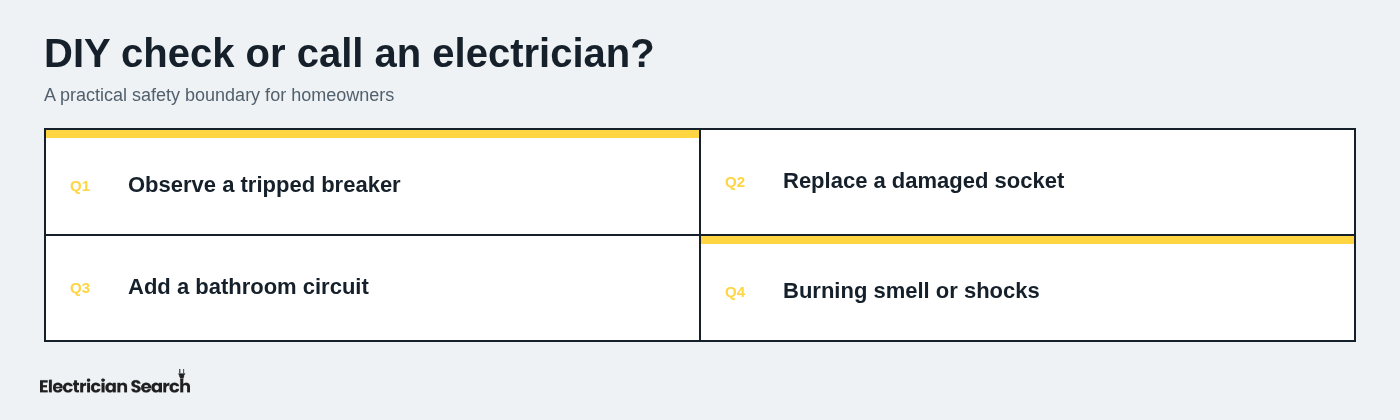
Some problems require urgent attention. If there is smoke, a burning smell, an electric shock, exposed wiring, water near electrical equipment or repeated loss of power, treat it as a safety issue rather than a weekend repair project.
Quick answer: common jobs a household electrician handles
- Consumer unit inspection, replacement and circuit alterations
- Extra sockets, replacement accessories and electrical repairs
- Indoor, outdoor and security lighting
- Fault finding for tripping circuits, failed sockets and intermittent power
- Partial and full rewiring
- Electrical safety checks and inspection reports
- Electric vehicle charger installations
- Extractor fans, smoke alarms and selected smart-home additions
The exact scope depends on the electrician's competence, any relevant registration and the condition of the property. Do not assume every electrician offers every specialist service simply because they carry out general domestic work.

Common home electrical jobs and the right time to call an electrician
The best time to involve an electrician is often earlier than homeowners think. Early advice can prevent a poor design, avoid opening up finished walls twice and reveal whether an apparent small fault points to a wider issue.
Repairs, fault finding and electrical safety problems
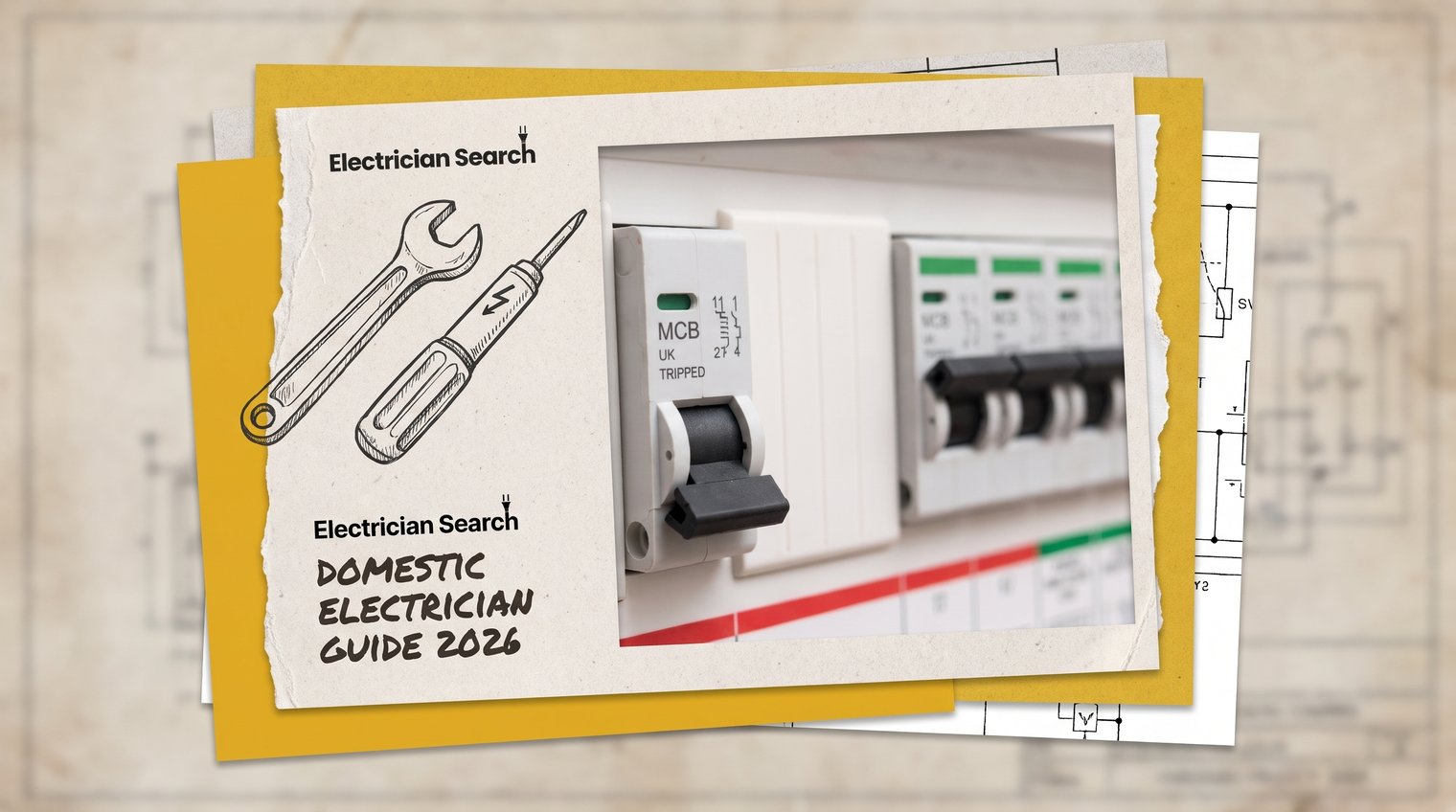
Call an electrician when circuits repeatedly trip, sockets stop working, lights flicker without an obvious bulb issue or power cuts affect only part of the property. A tripping RCD or MCB is doing its job by responding to a fault or abnormal condition; repeatedly resetting it without investigating the cause is not a repair.
Burning smells, scorch marks, buzzing, tingling or shocks from fittings, hot sockets and damaged cables all justify prompt professional assessment. Water-related problems deserve particular care: do not use equipment that has been wet or stand near electrics in a flooded area.
If it is safe to do so, switch off the affected circuit or isolate power using normal controls. Do not remove a consumer-unit cover, touch exposed conductors or attempt live-work repairs.
Upgrades and improvement projects
Many electrical projects are driven by how people now use their homes. Older rooms may not have enough sockets for home working, kitchen appliances can exceed the capacity of existing circuits, and a garden office may need far more than an extension lead through a window.
Common upgrades include additional sockets, new lighting layouts, extractor fans, consumer-unit upgrades, kitchen and bathroom work, outdoor power and EV charging. Bring an electrician in while plans are still flexible. They can assess circuit capacity, cable routes, protective devices and the practical implications of where you want switches, fittings and appliances.
That early conversation is especially valuable during a renovation. Moving a socket after plastering, tiling or cabinetry is installed is usually more expensive and disruptive than designing it properly at the start.
Inspection, testing and landlord-related work
An Electrical Installation Condition Report, usually called an EICR, is an inspection and test of an existing installation. It records observations and identifies issues that may require attention; it is not the same thing as carrying out repairs.
An Electrical Installation Certificate is generally associated with new installation work or significant alterations. A Minor Electrical Installation Works Certificate may be used for smaller additions or alterations. The appropriate documentation depends on the work, so ask what certificate will be issued before accepting a quote.
For landlords, electrical safety obligations make timely inspection and clear records particularly important. If an inspection identifies remedial work, expect that work to be separately assessed and quoted unless it was expressly included from the outset.
Electrical jobs you can do yourself versus work to leave to a professional
There is a difference between simple homeowner checks and electrical work. Replacing a lamp with the correct type or checking whether an appliance is damaged is one thing. Altering fixed wiring, opening electrical accessories or working at a consumer unit is another.
Even where work is not legally notifiable, safe electrical work still depends on competence, correct isolation, suitable equipment and testing. A circuit can appear to work after an alteration while still containing a hidden fault or inadequate protective measure.
Low-risk checks homeowners can make before booking
Useful observations can help an electrician diagnose the issue faster. Check whether neighbours have power if there is a wider outage, note which rooms and circuits are affected, and record what was running when the problem began.
- Check whether a plug, cable or appliance is visibly damaged, then stop using it.
- Look at the consumer unit only from the outside and note any tripped switch.
- If appropriate, reset a tripped device once using its normal control. If it trips again, leave it off.
- Take photos of visible damage from a safe distance and note any smell, heat or water exposure.
Never remove consumer-unit covers, dismantle sockets, bypass a safety device or probe wiring. Those actions can turn a manageable fault into a serious injury or fire risk.
Notifiable work and why Building Regulations matter
Some domestic electrical work in England may be notifiable under Building Regulations. In practical terms, notification is a formal process that can apply to specified work and helps ensure it is appropriately certified. Requirements and processes are not identical across every part of the UK, so do not rely on a rule you have seen online without checking how it applies where you live.
Before work starts, ask whether notification is required, who is responsible for it and what documents you will receive at completion. A competent contractor should be able to explain the route clearly, including whether they can self-certify applicable work through a relevant scheme or whether another arrangement is needed.
Qualifications, registration and competence: what to verify
"Qualified electrician" is a useful starting point, not a complete answer. What matters is whether the person or firm has the relevant experience and current competence for your particular job, along with a clear route for testing, certification and any required notification.
For example, an electrician who regularly handles domestic rewires may not be the strongest choice for an EV charger installation if they do not carry out those jobs. Equally, someone experienced in fault finding should be able to explain how they approach an intermittent problem rather than simply proposing replacements.
Is a Level 3 electrician fully qualified?
A Level 3 qualification can be an important part of electrical training, but it does not by itself prove that someone has the practical experience, inspection-and-testing capability, scheme registration or job-specific knowledge needed for every domestic project.
Ask about recent relevant work, who will complete the testing and certification, and whether the person attending will carry out the work themselves. For specialist jobs, ask about experience with that exact type of installation rather than relying on a qualification title alone.
Competent person schemes and third-party checks
Membership of an appropriate competent person scheme can be useful for certain domestic work because it may allow a registered contractor to self-certify applicable work. It should not be treated as a blanket guarantee of quality, but it is meaningful evidence to check alongside experience, insurance and written documentation.
Verify claimed registration directly through the relevant scheme rather than taking a logo or social-media profile at face value. Also ask who will do the installation, who will inspect and test it, and who will issue the final paperwork. Those are not awkward questions; they are basic project controls.
How to find a domestic electrician near you
Start by defining the job, your postcode and how urgent it is. "Domestic electrician near me" is a useful search, but a more precise search often produces better conversations: try adding terms such as "fault finding", "EICR", "consumer unit", "rewire" or "EV charger".
You can use ElectricianSearch to browse nearby listed electrical professionals and build a local shortlist. A directory is a discovery tool, not a substitute for checking the individual provider's experience, credentials, availability and suitability for your work.
Search locally with the right job brief
Give each electrician enough information to decide whether the job fits their service area and skills. Include your location, property type, the symptoms or intended work, any access limitations and whether you need a visit at a particular time.
For a fault, explain what has happened rather than diagnosing it yourself. For an upgrade, say what you want to power and where. "Need power in garden office" is less useful than "need a permanent supply for desk equipment, lighting and heating in a detached garden office."
Shortlist three suitable electricians before requesting quotes
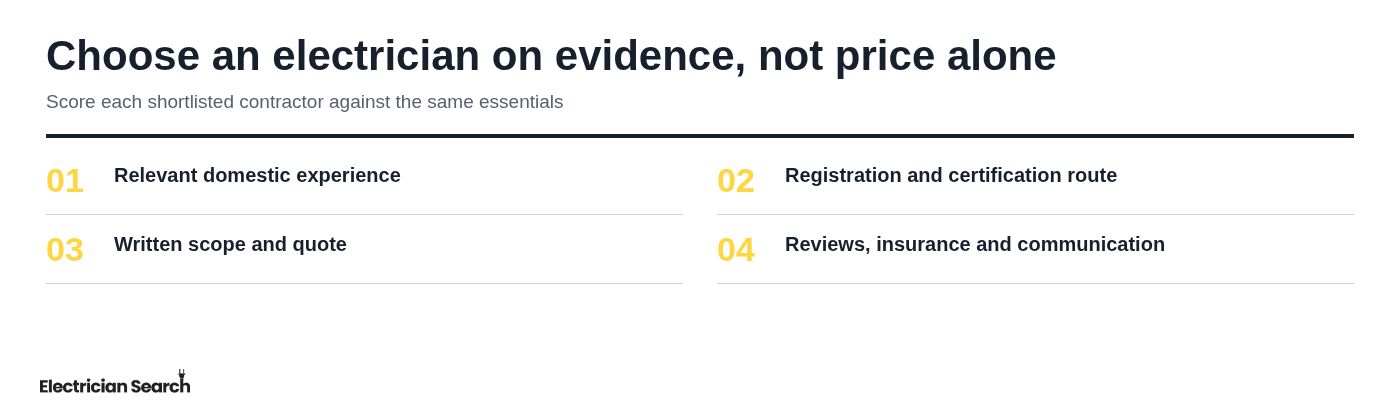
Three suitable candidates usually provide enough perspective without creating a long, unmanageable comparison exercise. Compare them against the same criteria: relevant domestic experience, certification route, public liability insurance, evidence from comparable customer work, responsiveness and the clarity of their questions.
Do not select solely on the lowest headline price, and be careful with unverified recommendations from social media. A low figure may be legitimate, but it may also omit testing, materials, certification, reinstatement or the actual work needed to resolve a fault.
ElectricianSearch

ElectricianSearch is most useful when you want to find and contact nearby electrical providers through location-based listings. It can reduce the time spent searching across separate local results, especially when you are beginning a shortlist rather than calling the first name you see.
Its meaningful limitation is that a listing alone cannot establish whether a provider is the right fit for your exact job. Use the directory to identify options, then ask each provider about their relevant experience, certification arrangements, availability and written scope.
How to choose the best electrician for your home
The best electrician is not automatically the closest, cheapest or most highly rated. Make the final choice by weighing the evidence gathered during your shortlist: fit for the job, clarity of scope, certification arrangements, insurance, communication and any relevant customer feedback.
Match experience to the exact job
A capable general domestic electrician may be an excellent choice for sockets, lighting and routine repairs, but a specialist system can require more targeted experience. EV chargers, solar-related work, complex fault diagnosis and major renovation projects all benefit from someone who regularly handles the relevant design and testing issues.
Ask for recent examples similar to your work. A useful answer identifies the type of property, the challenge involved and how the work was managed. A vague "yes, we do those" gives you little to assess.
Check communication, insurance and customer evidence
Look for clear communication from the start. A good electrician should be willing to explain the proposed scope, flag assumptions and tell you what they need to inspect before committing to a price.
Check that the contractor has appropriate public liability insurance and review customer feedback for comments about comparable work, punctuality, tidiness and problem solving. Be cautious if there is no paperwork, questions are brushed aside or you are pressured into immediate cash payment without a written record.
What to ask before you accept an electrician's quote
A quote should make the job clearer, not leave you guessing. Before accepting, ask enough questions to expose missing scope, unclear assumptions and uncertainty over who is responsible for testing and certification.
Also distinguish an estimate from a fixed quotation. An estimate is an informed indication that may change; a fixed written quotation is a commitment to a defined scope, subject to stated conditions.
Questions about scope, access and materials
- What is included, and what is specifically excluded?
- Which materials, fittings and brands are allowed for?
- Does the price include lifting floorboards, chasing walls, making good or redecorating?
- Are parking, travel, waste removal and access equipment included?
- What access is needed to the meter, consumer unit, loft, underfloor spaces or outdoor areas?
- How much disruption should we expect, and how long will the property be without power?
Tell the electrician about old wiring, previous alterations, damp, planned renovation work and known problems. Withholding awkward details rarely saves money; it simply increases the chance of a legitimate variation later.
Questions about testing, certificates and payment
- What testing will be completed after the work?
- Which certificate or report will be supplied, if applicable?
- Who will notify the work if notification is required?
- What happens if testing identifies an unrelated issue?
- When is payment due, and what payment stages apply?
For a larger project, staged payments tied to clear milestones are generally easier to manage than an unclear upfront arrangement. Agree how additional work will be authorised, ideally in writing, before it proceeds unless there is a genuine emergency.
How much does a domestic electrician cost in the UK?
There is no honest universal price for domestic electrical work. Costs vary by region, urgency, access, the age and condition of the installation, labour time, materials, testing requirements and what is discovered once work begins. For more context, see how much it costs to hire an electrician in the UK.
An electrical service call may include a call-out charge, a minimum period of diagnostic time, labour beyond that period and any parts used. Ask what the initial fee covers and whether it is credited against repair work. This matters more than comparing two vague call-out figures.
Estimate, quote and day rate: understand the difference
An estimate is an approximate expected cost. It is common for fault finding and work where cables, connections or defects are concealed. A quote is a fixed price for a defined scope, usually with stated exclusions and assumptions. A day rate is the labour charge for a day, often used where the final extent of work cannot reasonably be known in advance.
Prices may legitimately change if hidden defects, unsafe existing work or customer-requested changes emerge. The important point is communication: for non-emergency additions, ask for the revised cost and approve it before the extra work continues.
Why cheap electrical quotes can become expensive
A low quote can omit essential details: suitable protective devices, quality materials, testing, certification, waste removal or reinstatement. In the worst cases, inadequate work creates a second bill when another electrician has to diagnose, correct and certify it.
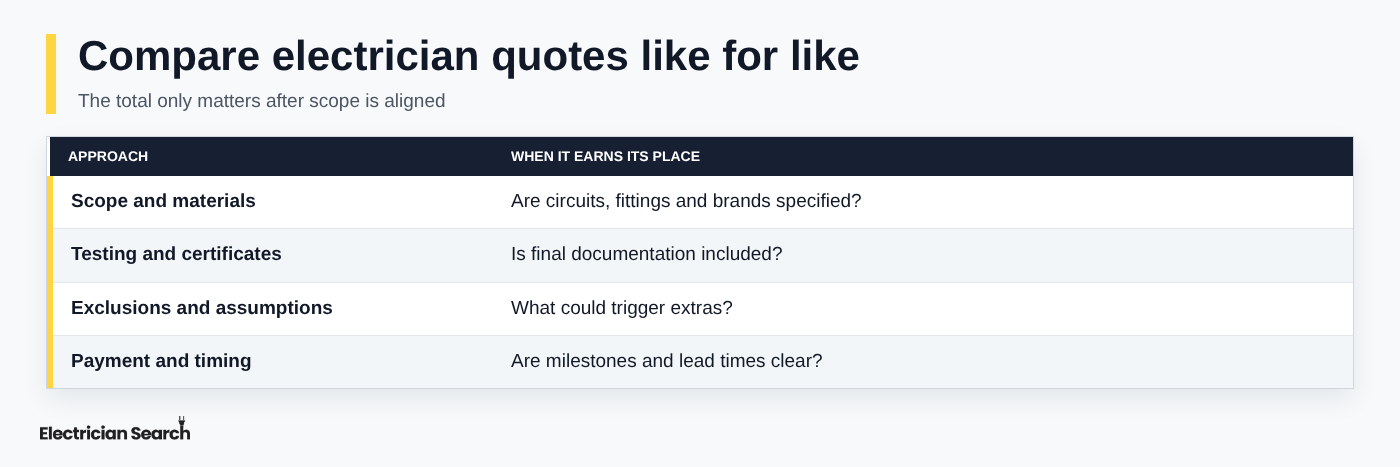
That does not mean the highest quote is automatically best. A higher total may include unnecessary work or generous allowances that do not match your needs. Compare the scope line by line, then ask why meaningful differences exist.
A worked example: comparing three electrician quotes for the same job
Suppose you are renovating a kitchen and need a consumer-unit replacement alongside new circuits for the oven, hob, dishwasher and worktop sockets. You also want under-cabinet lighting and an extractor fan. Asking for "a new consumer unit and kitchen electrics" invites wildly different prices because each electrician may assume a different job.
Turn a vague request into a comparable written brief
A clearer brief might say: replace the existing consumer unit; install dedicated circuits for the specified cooking appliances; provide a stated number of worktop sockets at agreed locations; install an extractor fan and lighting points; test the completed work; provide applicable certificates; identify whether wall chasing, patching and redecorating are included; and state access assumptions.
It should also mention the property is occupied, whether the kitchen is being stripped back, where the meter is located and whether there are known issues with the existing wiring. Those details prevent false price differences caused by one contractor allowing for a finished kitchen while another assumes open walls and empty rooms.
Compare inclusions, exclusions and risk - not just the bottom line
Imagine three fictional quote profiles. Contractor A offers the lowest total but lists only "consumer unit and kitchen points" with no brands, circuit schedule, testing or certificate specified. Contractor B is mid-priced and identifies the circuits, protective devices, fitting allowance, testing, certificate and exclusions for plastering. Contractor C is highest, but includes additional justified work after identifying poor earthing and a need for a supply upgrade.
Contractor B is often the easier quote to judge because the scope is visible. Ask Contractor A to revise their quote with the missing details before treating it as comparable. Ask Contractor C to explain the evidence for the additional work and whether it can be separated into an essential safety item and an optional improvement.
The right choice may be B, C or occasionally A after clarification. The point is that the totals only become meaningful when the work, materials, certification and risk assumptions are aligned.
Rewiring a house: signs, timing and planning
A rewire is one of the most disruptive electrical projects in a home, so it should be planned around wider renovation work wherever possible. It may involve opening walls and floors, replacing cables, upgrading the consumer unit and rethinking the location of sockets, switches and lighting.
Do not decide that a property needs rewiring based only on its age. Arrange a professional assessment if you are concerned about its condition, capacity or history of alterations.
At what age should a house be rewired?
There is no fixed age at which every house must be rewired. Condition, design, capacity, the quality of previous alterations and inspection findings matter far more than the year the property was built.
An older property may warrant particular attention before a purchase or major renovation, especially if it has outdated accessories, insufficient circuits, recurring faults, signs of damage or a long history of ad hoc changes. An EICR or targeted professional assessment can provide evidence for the next decision.
How to plan a rewire with less disruption
Plan room by room, but think ahead. Consider future socket needs, lighting zones, data points, smoke and heat alarms, kitchen loads, home-working space, garden power and possible EV charging. It is usually cheaper to provide sensible capacity during a rewire than to add it after the home is finished.
Agree a detailed design before walls are opened. Confirm cable routes, switch heights, fitting positions, consumer-unit location, access arrangements, making-good responsibilities and the sequence with plasterers, kitchen fitters and decorators. Phased work can be possible in occupied homes, but it needs careful planning around safety and temporary power.

Special domestic electrical work that needs extra scrutiny
Some work is not merely a variation on adding a socket. It affects high-load appliances, moisture-prone spaces, outdoor conditions or the overall capacity and earthing of the home. These projects need design questions answered before installation begins.
Bathrooms, kitchens and outdoor installations
Bathrooms involve electrical zones, moisture and strict equipment selection. Kitchens combine water with high-demand appliances, while outdoor installations must withstand weather, physical damage and the conditions in which they will be used.
Tell the electrician exactly what you intend to install and how you will use it. A hot tub, induction hob, electric shower, garden office heater and exterior lighting system all create different demand and protection considerations. Do not leave those decisions until after cables and fittings have been chosen.
Consumer units, EV chargers, solar and smart-home additions
Consumer-unit work, EV chargers, solar-related additions and smart-home systems can affect load assessment, earthing, compatibility and future expansion. A charger installation, for example, is not just about mounting a unit on a wall; the existing supply and protective arrangements must be considered.
Ask whether the electrician is responsible for the full process: design, installation, testing, certification and any coordination required with other parties. Clarify how later additions might be accommodated so that a project intended to modernise the home does not immediately create a capacity problem.
What happens on the day of the electrical work
Electrical work can be tidy and well managed, but it is rarely invisible. Expect the electrician to need access to the consumer unit, meter area and relevant rooms. Depending on the work, parts of the installation may need to be isolated while changes and tests are completed.
Prepare the property and protect the work area
Clear access to work areas, identify parking options and point out the meter and consumer unit. Move valuable or fragile items where practical, secure pets and make sure someone can answer questions about the property and approve reasonable decisions if needed.
Tell the electrician in advance about vulnerable occupants, medical equipment, home-working constraints or times when power interruption would be especially difficult. This allows the work sequence to be planned safely instead of negotiated halfway through the day.
Testing, handover and paperwork
Testing is part of the work, not an optional add-on. It may take time because the electrician needs to confirm that circuits, protective measures and alterations are operating as intended.
At handover, ask for an explanation of what changed and how to use any new equipment. Keep any certificates, notification information, test reports and maintenance instructions with your property records. They can be important for future work, insurance discussions, landlord compliance or a house sale.
Electrical emergencies: when to act immediately
Act promptly if there is a fire, smoke, a burning smell, an electric shock, exposed live parts, flooding near electrical equipment or loss of essential power that creates immediate risk. Do not put yourself in danger to investigate.
If there is immediate danger to people or property, contact the emergency services. If it is safe and you know how to use the normal controls, isolate the affected supply without touching damaged equipment. Keep people away from the area, particularly where water, damaged cables or exposed parts are involved. For a suspected wider supply outage, contact the electricity network operator; for an isolated fault within your home, seek an emergency electrician.
Choose a domestic electrician with confidence
A reliable process is straightforward: define the job, record the important symptoms or requirements, shortlist suitable local electricians, verify relevant competence and compare written scopes rather than headline prices. Before work starts, agree who will test, certify and, where necessary, notify the work.
Keep the paperwork after completion and do not treat warning signs as a DIY challenge. When you are ready to begin a local shortlist, use ElectricianSearch to find nearby listed electricians, then make your final choice using the evidence that matters for your home and job.