Choosing the wrong EV charger installer can leave you with more than an awkward-looking cable run. A rushed installation may uncover supply limitations late in the job, omit necessary electrical work, or leave you unclear about certification and warranty support.
A home charger is not simply a device to mount on an outside wall. It needs a suitable circuit, the right protective measures and an installer who understands both domestic electrical systems and EV charging equipment. Use this checklist to compare electricians before you commit.
Start with the right installer: what an EV electrician must be able to do
Can any electrician install an EV charger? Not automatically. A qualified electrician may be competent in many types of domestic work, but a home charging installation also calls for familiarity with EV equipment, current manufacturer instructions and the practical issues that affect charging at a property.
A specialist EV electrician or an experienced domestic electrician with a track record of charger installations is usually the better choice. They should be able to assess the property, design the installation route, install the equipment, test the new circuit and provide the appropriate paperwork afterward.
- Confirm recognised electrical competence. Ask how the electrician demonstrates competence for domestic electrical installation work and which certification route they use. This is more meaningful than relying on a vague claim of being "fully qualified."
- Choose someone with EV charger experience. An installer who regularly handles home chargers is more likely to spot issues with cable routing, electrical capacity, connectivity and load management before work starts.
- Check familiarity with your charger requirements. Different chargers have their own fitting, setup and connectivity requirements. Your installer should be prepared to follow the instructions for the model you choose.
- Make sure they can test and certify the finished work. Fitting the box to the wall is only one part of the job. The electrician must be able to inspect, test and certify the installation as required.
Essential: confirm electrical competence and installation certification
Ask the electrician what documentation you will receive when the job is complete. They should be able to explain how the installation will be inspected and tested, and what electrical installation certificate or other relevant paperwork will be issued.
Do not accept an arrangement where someone only mounts and connects the charger while leaving testing and certification as an afterthought. A proper installation includes the electrical work behind the charger, not just the visible unit.
Essential: ask about EV-specific installation experience
You do not need to interrogate an electrician, but a few direct questions reveal whether they understand the work. Ask how many comparable home installations they have completed, which charger brands they have fitted and whether they have dealt with load management or limited supply capacity.
It is also useful to ask about difficult cable routes, detached garages, long driveways or consumer units with little spare room. Experience with those situations matters more than a generic promise that any charger can be installed anywhere. Manufacturer approval may be relevant for some products, but it is not automatically required for every charger.
Check whether your home is ready before requesting quotes
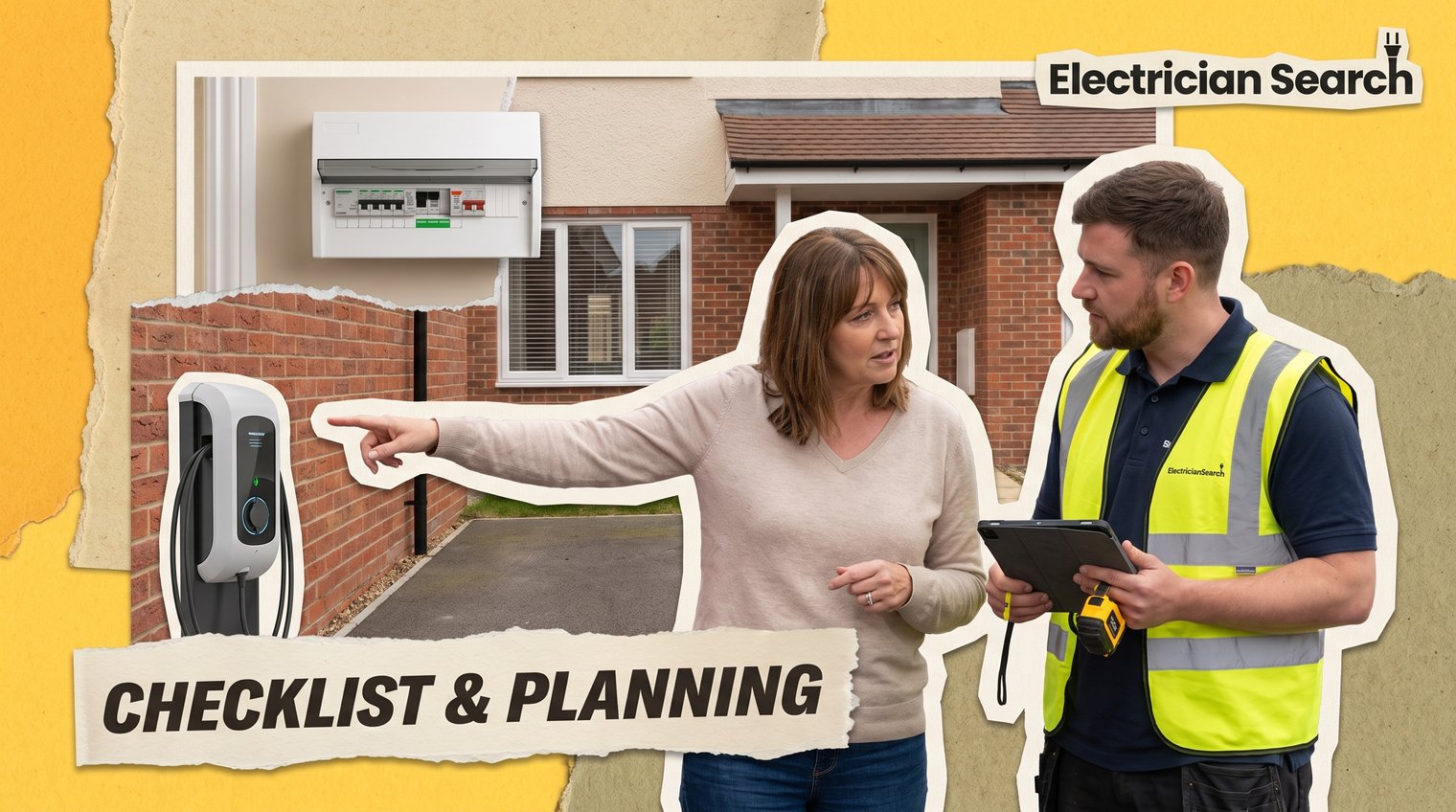
Good quotes start with good information. Before you search for an electrician to install an EV charger near you, take a few photos and note the practical details of your property. This helps installers give a realistic initial view, although it does not replace a site survey when one is necessary.
- Photograph the proposed charger location. Include the wall, parking space and surrounding obstructions so the electrician can see whether the unit will be exposed to impact, weather or restricted access.
- Photograph the consumer unit and meter area. Clear images can help identify obvious constraints, but the installer still needs to assess the equipment in person where appropriate.
- Measure the likely cable route. Note the approximate distance from the consumer unit to the charger position, including runs through garages, lofts or outside walls.
- Check signal at the charger location. If you want a smart charger, confirm whether your Wi-Fi or mobile signal reaches the planned location.
- Identify permission requirements early. Tenants, leaseholders and owners of shared bays may need approval before installation can proceed.
Essential: identify the parking space and practical cable route
The charger should serve the place where the vehicle normally parks. A driveway, garage or carport is usually straightforward enough to assess, while communal parking often needs much more planning.
Do not assume a cable can simply run over a public pavement from your house to the car. Trailing cables create safety and access problems and are not a sensible default solution. Instead, ask the electrician to consider where the cable enters the property, how it will be protected from damage and whether the route remains safe in all weather.
Think about everyday use too. A charger hidden behind a parked car, positioned where a gate will strike it, or fitted too far from the charging port may technically work but quickly become annoying.
Essential: check the consumer unit and electricity supply
Your electrician needs to assess more than whether there is an unused way in the consumer unit. They may need to consider available capacity, the earthing arrangement, suitable protective devices and whether the charger requires a dedicated new circuit or related consumer-unit work.
If the property's supply needs upgrading, the local electricity network operator may be involved. That can change both the cost and the timeline, so it is better to identify the issue early than to discover it after a charger has been ordered.
Decide what charger specification actually suits your car and routine
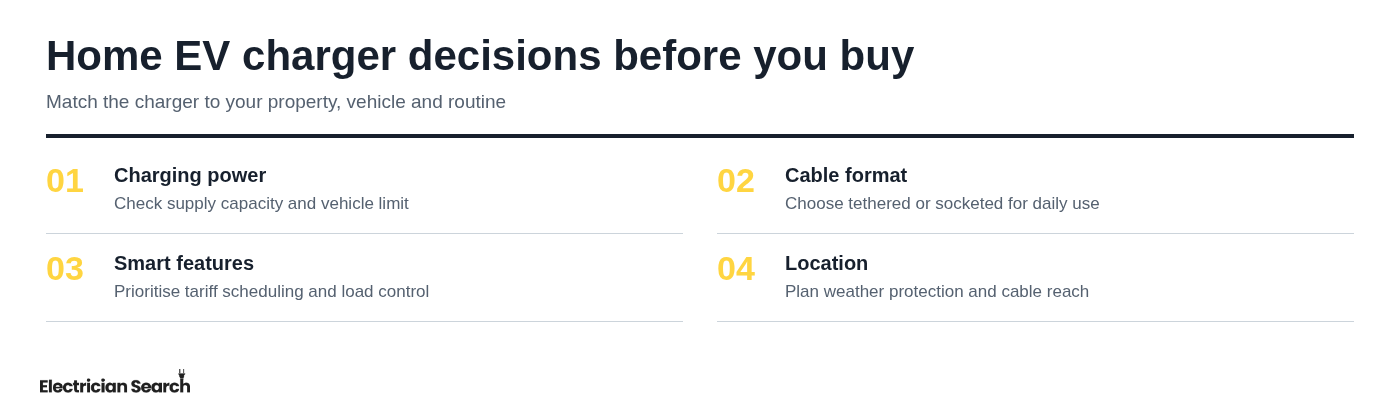
Buying the highest-rated charger available is not automatically the smart choice. Your vehicle's charging capability, the property's electricity supply and your daily mileage all affect what will be useful in practice.
Give installers enough detail to recommend or quote for a suitable unit: your car model, typical return-home time, usual departure time, expected daily miles and where you park. That turns the conversation from "what is the fastest charger?" into "what will reliably meet my needs?"
Essential: match charging power to your supply and daily mileage
Home chargers are available at different charging powers, but the practical result depends on the vehicle and the house. A faster-rated unit cannot make a car accept more power than it is designed for, and it cannot bypass limits in the incoming supply or household demand.
For many drivers, overnight charging is the key consideration. If a lower-power option comfortably replaces a normal day's driving while the car is parked, paying for a more complex arrangement may add little value. Your electrician should assess the supply and explain the trade-offs rather than offering a universal recommendation.
Nice-to-have: choose smart controls you will use
Smart features can be genuinely useful when they fit your routine. Scheduling can help you charge during an off-peak tariff window, while app controls may make it easier to monitor charging or change a timed session. Solar compatibility and load balancing can also be worthwhile for the right household.
Ask whether the proposed charger depends on reliable internet access and what functions remain available if broadband drops out. A feature you cannot use consistently is not a reason to choose a more expensive unit.
Get a written electrician estimate you can compare fairly
A short message quoting one total price is not enough for anything but the simplest installation. The estimate should make clear what charger is being supplied, what electrical work is included and what could trigger additional cost.
The cheapest estimate is often not the cheapest finished job. It may omit a longer cable route, consumer-unit changes, groundworks, testing or the documentation you need after installation. For broader budgeting context, see How Much Does It Cost to Hire an Electrician in the UK?
Essential: make sure the quote states what is included
Ask for a written scope that separates the main cost elements rather than hiding everything inside a vague "standard installation" label.
- Name the charger make and model. You need to know exactly what is being supplied, including whether a cable is built in or separate.
- Specify the cable length and route. A quote should state the assumed route and make clear whether extra distance, drilling or difficult access would cost more.
- Include electrical alterations. Confirm whether a new circuit, protective devices, consumer-unit work or load management equipment is included.
- Include testing and certification. These are core parts of a completed electrical installation, not optional add-ons.
- State VAT and exclusions. Ask whether VAT is included and whether groundwork, repairs to finishes, supply upgrades or permissions are excluded.
Also ask what happens if the survey finds inadequate capacity, inaccessible routes or materials that require specialist handling. A clear process for variations is far better than an argument over an unexpected bill on installation day.
Essential: compare like for like, not just the headline price
When comparing estimates, check the proposed charger quality, cable route finish, circuit protection, warranty process and aftercare. Two quotes that look similar at the top may cover very different work.
For a non-standard property, obtain more than one detailed estimate. This is especially useful for detached garages, long cable runs, older consumer units, flats and properties where the car parks away from the main building.
Ask how the electrician will protect your home and installation
You do not need to design the electrical system yourself. That remains the installer's responsibility. But you should expect them to explain the essentials: how the charger will be supplied, how the cable will be routed safely and how the completed work will be tested.
- Confirm a dedicated circuit will be considered. A home charger should not be treated as just another plug-in appliance on an existing general-use circuit.
- Ask about safe cable routing. The route should avoid avoidable damage, trip risks and exposed sections where vehicles, doors or garden equipment could strike it.
- Ask how earthing and protective measures will be assessed. The electrician should make the compliant technical decisions for your specific property and charger.
- Confirm testing is part of the quoted work. Testing verifies the installation after the physical fitting is complete.
Essential: confirm testing, certification and handover
Before paying the final balance, make sure you know what happens at handover. You should receive the relevant electrical installation documentation, instructions for using the charger and a clear explanation of any controls you will need day to day.
If the charger has an app, ask whether setup and basic settings are included. Confirm how warranty registration works, who handles manufacturer warranty claims and whom to contact if a fault develops after installation.
Check insurance, warranties and accountability
Professionalism is not only about technical ability. You need a business that can be contacted, explains its terms clearly and remains accountable if something goes wrong.
- Check public liability insurance. Ask for confirmation that the installer has appropriate cover for work at your home.
- Ask about the workmanship guarantee. Product warranty and installation workmanship are different things, so establish the length and terms of each.
- Clarify charger warranty handling. Find out whether you deal directly with the manufacturer or whether the installer supports fault diagnosis and claims.
- Verify business contact details. Keep the company's name, address where available, telephone number and written quote in your records.
- Read recent reviews in context. Look beyond star ratings for comments on communication, punctuality, tidy work and how problems were resolved.
Know when a normal house socket is not the answer
A regular domestic socket is not a substitute for a properly designed home charger. Occasional low-rate charging may be possible where the vehicle manufacturer permits it and the electrical installation is suitable, but repeated high-load charging through an unsuitable socket is a poor long-term plan.
Do not rely on extension leads, worn outlets or improvised outdoor connections. They introduce avoidable risks and do nothing to solve the question of whether the circuit can safely support the load. If you are uncertain, ask an experienced EV electrician to assess the property before making charging part of your everyday routine.
Plan for permissions, flats and shared parking early
Permission can be the longest part of an EV charging project. If you rent, live in a leasehold flat, own a parking bay separately from your home or share parking with neighbours, establish the rules before paying for detailed design work.
- Get landlord consent in writing. Tenants should not assume a charger can be installed on an outside wall or in an allocated space without approval.
- Check leasehold and freeholder requirements. The building exterior, parking area or electrical infrastructure may be controlled by a managing agent or freeholder.
- Confirm who owns the parking bay. An allocated bay is not always owned outright, and the answer affects what can be installed.
- Identify shared electrical infrastructure. Communal installations may need a wider assessment of metering, supply capacity, billing and future access for other residents.
- Consider location constraints. Listed buildings, conservation restrictions and private parking rules can affect the location and appearance of equipment.
Use this final EV electrician checklist before you book
Use the essential items to rule out unsuitable installers and incomplete quotes. Nice-to-have points can help you choose between two electricians who both meet the basics.
Essential checks
- Confirm the electrician can inspect, test and certify the installation. Do this before accepting a quote, not after the charger is fitted.
- Ask about recent home EV charger installations. Relevant domestic experience helps with real-world issues such as cable routes and constrained supplies.
- Arrange a proper assessment where the property is not straightforward. Photos help, but they cannot reveal every issue in a consumer unit, garage or cable route.
- Have the supply and consumer unit assessed. The electrician must determine whether the home can support the proposed charger and what additional work is needed.
- Get a written scope with the charger model and all included work. Check cable route, electrical alterations, testing, certification, VAT and exclusions.
- Confirm handover documents and charger setup. You should receive relevant certification, user guidance and a route for reporting faults.
- Check insurance, workmanship cover and product warranty responsibilities. Know who is accountable for the installation and who supports a charger warranty claim.
- Obtain permissions before booking work. This is essential for tenants, leaseholders, flats and shared or communal parking arrangements.
Nice-to-have improvements
- Choose smart scheduling if you have an off-peak tariff. It can make charging cheaper when it matches the way you already use your car.
- Ask about load balancing where household demand is high. This may help the charger work alongside other significant electrical loads.
- Plan for future vehicle changes. If you expect to replace your EV or add a second electric car, discuss whether the route and equipment allow sensible future expansion.
- Check connectivity before choosing app-dependent features. A charger location with weak Wi-Fi may affect how useful remote controls and tariff features are.
Homeowners looking for an EV electrician near them can use ElectricianSearch to find local electrical professionals and start the quote process. Prioritise a transparent scope, an honest assessment and proper certification over the fastest promise or the lowest headline price.